Rules of Origin and Industrial Policy: Levers, Disconnects and Pathways to Alignment
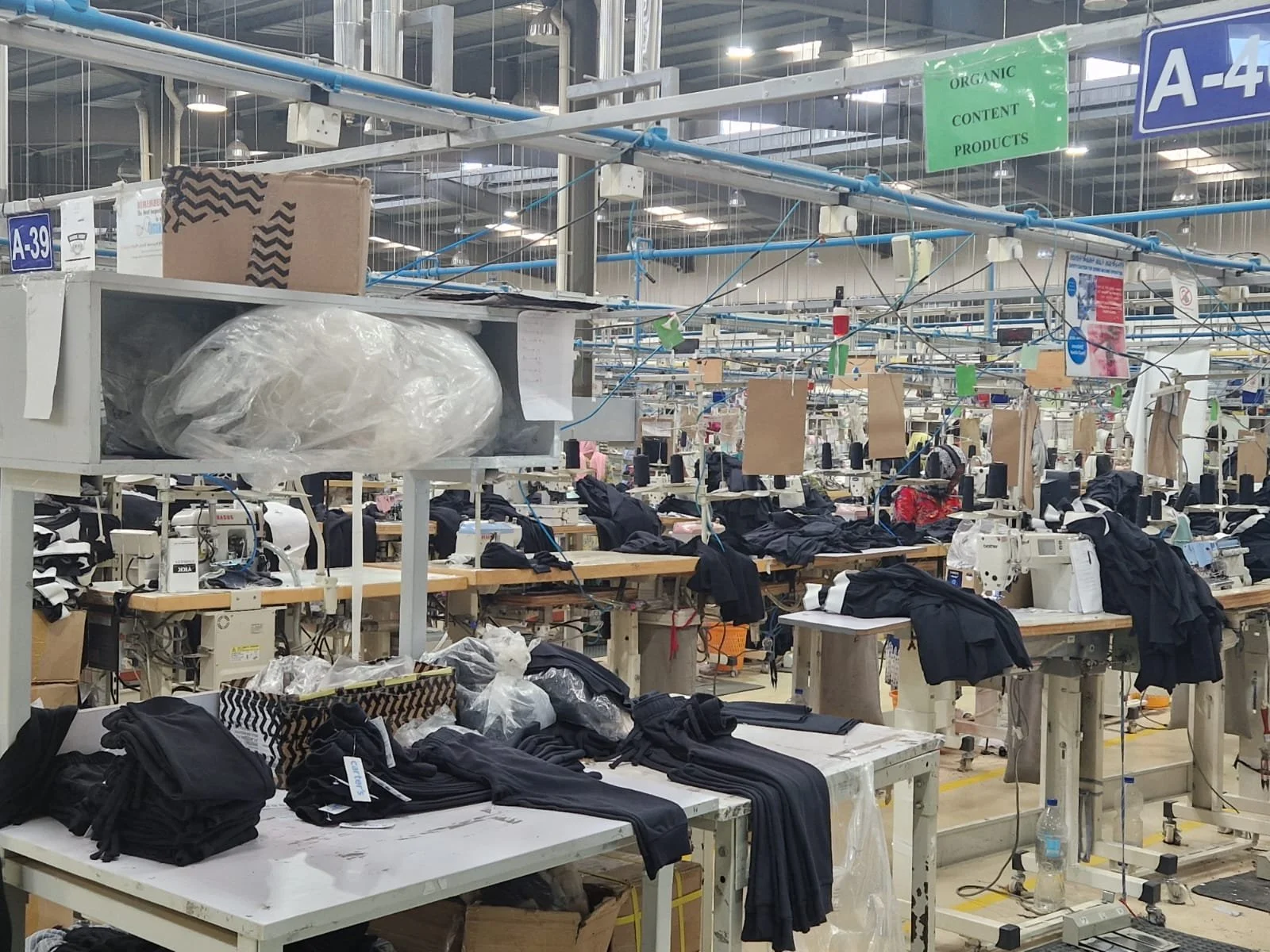
Apparel manufacture in Ethiopia
This article is a further reflection on How to Negotiate an Industrial Policy Under AfCFTA, the policy paper co-authored with Luladay Berhanu Mengistie and published in September 2026 by the Policy Center for the New South.
"AfCFTA's most granular industrial policy lever is thus being operated with an industrial-development narrative, but without any policy guidance."
Luladay Berhanu Mengistie & Guillaume Gérout Suominen
-
Product-specific rules of origin are the AfCFTA's most granular industrial policy instrument. Each rule determines where transformation must take place for a good to trade preferentially, and therefore where investment in productive capacity pays off.
The bodies that write the rules and the bodies that formulate industrial strategy operate on separate tracks. The Sub-Committee on Rules of Origin receives no systematic industrial-policy guidance, and no organ reads the tariff schedules and origin rules together as a continental industrial geography.
The rules of origin are approaching revision just as the Protocol on Industrial Policy and Development enters negotiation. Deliberately connecting the two processes is the least expensive alignment opportunity the negotiators will get.ext goes here
Introduction
In February 2026, African Union Heads of State and Government directed the AfCFTA Council of Ministers to negotiate a Protocol on Industrial Policy and Development as an integral part of the AfCFTA legal framework. The mandate derives from two key observations. First, intra-African trade carries a proportionally larger share of manufactured goods than Africa's trade with the rest of the world, yet it remains stuck at around 16% of the continent's total trade. Second, the productive capacity needed to fill the market the AfCFTA creates is still shallow. If the agreement is to deliver structural transformation, it must stimulate production alongside market access.
The paper referenced above maps the preparatory questions this negotiation raises: what definition of industrial policy is precise enough for treaty language, what the continental landscape already contains, what is realistically negotiable, and what governance functions any institutional answer must perform. This article pulls on a single thread of that mapping, the one closest to this blog's concerns: rules of origin.
A previous article on this blog asked whether rules of origin could serve an objective they were not designed for. Industrial policy presents the reverse situation. Rules of origin have always served this objective in practice. What is missing under the AfCFTA is not the lever, but the hand on it.
Rules of origin are already industrial policy tools
Preferential rules of origin set the conditions under which a good qualifies for preferential treatment. The product-specific rules (PSRs) in Annex 2 of the Protocol on Trade in Goods do this at the level of individual products. For each, the rule specifies which transformation must occur within the AfCFTA market. Whether it is expressed as a value-added threshold, a required change of tariff classification, or a prescribed process, each choice determines which production configurations earn the preference, and therefore where, along a value chain, investment in African productive capacity is rewarded.
This is industrial policy in everything but the name. The AfCFTA has this specificity, though, as Annex 2 lists promoting industrial development among the rules' objectives. The paper argues that the PSRs were nonetheless negotiated primarily as trade instruments. Preventing circumvention shaped the discussion; industrial strategy did not, at least not systematically.
The incentive logic set out in the previous article applies here unchanged. Preferences are optional. Companies claim them only when the expected benefits exceed the compliance costs. A rule so restrictive that few producers can meet it delivers protection without ensuring any gain in terms of production. In this case, the preference goes unused, trade continues at non-preferential duties, and the industrial effect the rule was meant to generate never materialises. Preference utilisation, not restrictiveness, tests a rule of origin's industrial value.
The negotiating dynamics compound the problem. The most sophisticated economies have advocated origin thresholds aligned with their current production capabilities, while less-diversified members, precisely those who would benefit from rules that promote new capacity, are often the least equipped to articulate and defend their positions. Rules calibrated to existing strength consolidate the existing industrial geography. They do not extend it.
The disconnect
The Sub-Committee on Rules of Origin is a technical trade body. It develops product-specific rules without systematic input from industrial strategy. The most granular industrial policy lever in the agreement is therefore operated with an industrial-development narrative, but without policy guidance on what the rules should be steering toward.
The problem repeats at every level of the architecture. No organ reads the AfCFTA's tariff schedules, sensitive lists and origin rules together at continental level, so their combined effect on where industrial production locates is simply unknown. And the terrain is itself moving: the same February 2026 decision that mandated the Protocol also ordered a review of the tariff modalities and the phase-out of the exclusion lists.
Above the agreement, sectoral African Union instruments create industrial-policy expectations that origin provisions can support or undercut. The Continental Automotive Strategy, the Africa Mining Vision, the Pharmaceutical Manufacturing Plan for Africa and the Blue Economy Strategy each imply something about how origin should treat their sectors. No standing mechanism translates them into origin-relevant substance; the relationship is managed ad hoc, when it is managed at all.
The consequences of this disconnect surface late and expensively: in preferences that go unused, in investment that locates elsewhere, and eventually in dispute settlement, where panels interpreting exceptions and performance requirements will reach by default for WTO jurisprudence rather than for the African Union's own industrial framework.
The revision and the Protocol: a coincidence worth engineering
Two processes are now running in parallel. The rules of origin are approaching revision, as recorded at the Council of Ministers in July 2026, and the Protocol on Industrial Policy and Development is entering negotiation. Nothing currently connects them. Building that connection into the negotiation design is the paper's most concrete recommendation, and this article's central point. Three elements would give it substance.
Sequence the origin review by value chain. Priority value chains for intra-African trade have already been identified: work by the International Trade Centre with the African Union Commission and the European Commission flagged 94 high-potential chains, with automotive, pharmaceuticals, clothing and cotton among the most promising. Reviewing the PSRs for these chains first, against existing sectoral strategies, would anchor the revision in industrial priorities rather than negotiating convenience.
Give the Sub-Committee an industrial counterpart. Among the governance functions the paper identifies, coherence reading is the one the origin process needs most: an ongoing, cross-instrument assessment of how tariff schedules, origin rules, services commitments and the Phase II disciplines combine. Its output would reach the Sub-Committee as policy guidance, so that the most granular lever in the agreement is operated with a view of the machine it belongs to.
Integrate rather than layer. The conclusion reached for environmental sustainability holds for industrial policy. Objectives layered on top of origin requirements produce two compliance burdens; objectives integrated into the alternative structure of the rules produce a choice. Tiered rules that make the industrially preferable configuration, such as deeper regional sourcing or higher-value transformation, the economically easier route turn industrial policy from a condition into an incentive.
Concluding remarks
The paper's broader argument is that the Protocol's success depends less on the ambition of its text than on the work that precedes drafting: a workable definition, a systematic mapping of what the AfCFTA already contains, and a candid reckoning with the institutional tensions that have constrained the agreement so far. For rules of origin, that preparatory work has a deadline attached. The revision will determine whether the Protocol's industrial commitments become operational or remain aspirational.
Rules of origin will shape Africa's industrial geography either way. The only question the negotiators can still decide is whether they do so by design or by default.