Trade negotiations often fail because they are exclusive, overly complex, and divisive.
Design inclusive, participatory and efficient negotiation processes that result in adopted and implemented agreements.








The tragedy of exclusive trade negotiations
The technocratic process issue
Why do intergovernmental negotiations fail?
Access to information. Beyond the issue of information availability, access to it often remains limited. Whether within organisations themselves or between cooperating organisations, the flow of information is friction-laden, which, over time, tends to concentrate knowledge among a limited number of people, creating the risk of making decision-making distant, obscure, exclusionary, and biased.
Appropriation of processes. Even when genuine efforts are made to facilitate access to information, the latter does not always resonate with decision-makers. While this phenomenon is often explained by a lack of capacity to integrate, analyse, and use information, the result is that legal instruments in which significant resources have been or are being allocated remain unused, representing a dead loss for the community.
What is the cost of failed negotiations?
Low implementation. Underutilised agreements lead to a loss of competitiveness, increased trade costs, and strategic misalignment. Despite the promising potential and significant taxpayer investment in policy reforms, these agreements are often left unused. This not only undermines confidence in the private sector but also exacerbates social tensions and complicates the policy environment.
Institutional coherence. Vague principles and ill-defined negotiating frameworks create fragmentation within the very trading landscape the agreement aims to integrate. Rather than simplifying implementation, unresolved principles complicate it and add another layer to an already fragmented system.
The technical assistance trap
Governments and intergovernmental agencies resolve the technocratic process issue through technical assistance
-
Punctual interventions functioning in closed loops and siloes.
The same people keep getting the same trainings over and over, without much ownership or retention.
Result: The same requests yielding the same results. Every single time.
-
A handful of organisations get invited to be talked at, rather than participating in a real dialogue, where decisions are presented as a fait accompli.
Participants come to co-construct. They leave with a thick stack of PowerPoint slides and little say.
Result: Public lose interest and in faith in a top-down process in which they are give a figurative role under cover of a participatory process. Everyone loses.
-
Governmental agencies and intergovermental organisations communicate late and narrowly on media only they consumue.
The information becomes available but remains hardly accessible. So they make it up with unnecessary goodies that clutter shelves.
Result: Visible walking billboards and important information lost in the limbos of the Internet
The consequence of it all is much ado about little, at the expense of the taxpayers.
There is a better way…

Empowered negotiations. Enhanced opportunities.
Trade agreements that work for people.
Secure the social license to negotiate
Going the extra mile
What is the social license to negotiate?
Borrowing from Corporate Social Responsibility, the Social License to Operate (SLO) is the acceptance of a project by affected communities, grounded in trust, dialogue, and long-term relationships rather than simple compliance with legal and regulatory consultative obligations. In public-private dialogue and policymaking, SLO can establish a structured framework for ongoing collaboration among government, the private sector, and civil society. This approach encourages shared decision-making before major choices are finalised, ensuring accountability through continuous monitoring and partnerships.
By moving from top-down decision-making to collaborative planning, policymakers and interest groups can co-design development projects with communities, incorporating local knowledge, environmental concerns, and social impacts from the start.
This is the Social License to Negotiate (SLN).
Why does it matter?
Without genuine community engagement, governments - with the support of a few, powerful interest groups - often proceed with projects that communities oppose or that harm local environments and livelihoods, leading to conflict, project delays, community distrust, and failed initiatives.
SLN shifts the framework from "How do we convince communities to accept what we've already decided?" to "How do we build legitimate partnerships where communities have real influence on decisions?"
Inclusive co-constructive processes create beneficial relationships among various stakeholders, pressure groups, and policymakers. By promoting shared visions on how regional agreements interact, these processes enable faster decisions, supported by thorough interdisciplinary analysis. This approach helps avoid costly mistakes and shapes negotiating positions, allowing a shift from uncertainty to strategic action, backed by the evidence required to support national strategic choices.
For governments and interest groups, SLN reduces operational and reputational risk.
For communities and NGOs, it transforms them from passive recipients of decisions into active participants with leverage, enabling them to protect their territories, secure resources for local development, and ensure that projects respect both people and environment.
How does it work?
Functional trade negotiation dynamics require much more than mere consultations.
SLN-backed processes ensure the negotiations stay on track...


Séliatou Kayodé-Anglade
Manager, Sustainable and Inclusive Economy Department
"Mr. Gérout Suominen has contributed significantly to advancing the negotiations of the African Continental Free Trade Area (AfCFTA), notably through the coordination and facilitation of consultation meetings and informal discussion groups, as well as through the technical support provided to senior officials of the AfCFTA Secretariat."
Share evidence-based insights
Generate high-level impact.
Secure trade and reduce compliance costs for businesses.
Lay legal foundations that benefit millions.
Rely on evidence-based advice.
Legal and regulatory analysis that informs policymakers on what matters most.
Support social and environmental justice for all.
The more we share, the more we care.
Making one’s interests known creates rapport, trust, and cohesion towards shared goals…

Barry Faure
Secretary of State, Seychelles Ministry of Foreign Affairs & Regional Integration
"[Mr. Gérout Suominen’s] technical knowledge and mastery of the subject have enabled him to provide accurate information and robust advice to the Government […]. He has no doubt contributed to the leading, forward-looking and open-minded stance that Seychelles has shown in pushing for an acceleration of the [EU-Eastern and Southern Africa (ESA) Economic Partnership Agreement] negotiations within the ESA region."
Bridge the national-international decision-making gap
How do negotiators prepare their negotiating positions?
Trade negotiations are complex, multi-layer environments.

Source: Gérout (G.), Negotiating institutions: Putting in Place the Right Foundations, UNECA, 2022
Why do negotiators compromise on agreed-upon decisions?
Trade negotiators aim to find a balance between domestic interests and international compromises.
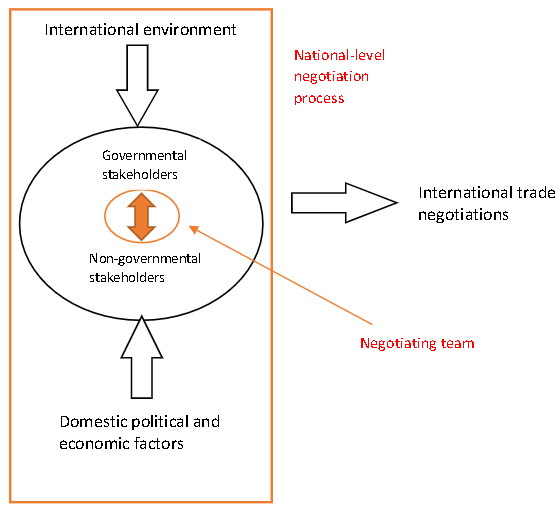
Source: Gérout (G.), Negotiating institutions: Putting in Place the Right Foundations, UNECA, 2022
Successful negotiators and lobbyists know how to navigate multi-layered environments and dynamic sequences.
Getting the right message to the right person, at the right moment…

Didier Bonyeme
Head of Unit, Rules of Origin Policy Unit
"The research work and technical and strategic support provided by the team under the direction of Mr. Gérout Suominen have made a valuable contribution to the work of the AfCFTA Secretariat and have enabled notable advances in the missions entrusted to the Secretariat by the States Parties. In particular, the economic analyses of African regional trade agreements have shed new light on the obstacles encountered during negotiations. These analyses led to new approaches that enabled the Secretariat's proposals, which helped successfully conclude the negotiation process, particularly in the sectors of fishing, automobiles, and textiles."
Featured in